Stop Treating Lenzing™ TENCEL™ Like A Simple Fabric Choice
-
Here's the thing about Lenzing fabrics: If you're treating them like a line item on a spec sheet, you're doing it wrong.
-
The Assumption That Costs You Money
-
What 'EcoVero with REFIBRA™' Actually Means To A Factory
-
The Real Cost of 'Green' Fiber
-
So, How Do You Specify It Right?
-
Final Thought: Don't Be Afraid To Question 'Premium'
Here's the thing about Lenzing fabrics: If you're treating them like a line item on a spec sheet, you're doing it wrong.
I've been a quality compliance manager in textile sourcing for years. I review roughly 200+ fabric deliveries annually. And in Q1 of this year alone, I rejected 12% of first deliveries from mills. The number one cause? Misaligned expectations about how 'premium' a fiber actually behaves. People see 'TENCEL™' or 'Lenzing Modal' and assume it solves everything. It doesn't. It solves specific problems, but it introduces new ones if you don't know what you're asking for.
My job is to stop things before they ruin a production run. So let me tell you what I've learned about specifying Lenzing fibers—and why the most expensive mistake you can make is treating them like 'just another fabric.'
The Assumption That Costs You Money
Most buyers assume that specifying a fiber is like ordering a sandwich: you pick the bread (cotton, polyester, rayon) and the filling (finish, weight, color). The reality is more like ordering a custom engine for a car. You need to know the torque, the tolerances, and the fuel it burns.
From the outside, Lenzing fibers look like a premium alternative to standard viscose or cotton. The reality is that terms like 'TENCEL™ Lyocell' and 'EcoVero™ Viscose' are specific, trademarked formulations with narrow processing windows. If you send a spec that just says 'Lenzing Modal' to a mill in Asia, you're asking for trouble.
People think a cheaper mill can handle premium fiber the same way. Actually, the fiber quality only shines if the mill's finishing process is calibrated to it. The causation runs the other way: you buy the fiber, then you fit the factory to the fiber.
This disconnect cost one of our partners a $22,000 redo last year. They sourced a flannel twill fabric described as 'TENCEL™' from a new supplier. The hand-feel was off, the drape was wrong, and the color depth was uneven. The mill claimed it was 'within industry standard.' We rejected the batch. The problem wasn't the fiber—it was that the mill had treated it like standard lyocell and skipped the specific dyeing protocols Lenzing recommends for its branded fibers.
What 'EcoVero with REFIBRA™' Actually Means To A Factory
This is where my role gets specific. The brand configuration tells us Lenzing's core products include EcoVero Viscose with REFIBRA™. This is a fantastic product for sustainability claims. But here's what I've seen on the ground: not every 'Lenzing fabric manufacturer in Asia' is actually set up to process it.
Certification is a paper trail. The real test is the production audit. When I review a delivery, I look for three things:
- Certification vs. Reality: Is the claimed fiber actually in the fabric? We do spot checks.
- Fiber-to-Finish Compatibility: EcoVero has a different fibrillation tendency than standard Modal. If the mill's finishing line isn't set for it, you get pilling.
- Waste Management: REFIBRA™ is partially recycled cotton scraps. The fiber's performance changes slightly with the blend ratio. Is the mill tracking this?
If you ask a mill for 'a modal fabric for a window treatment' (I see this keyword: modal window), and they quote you a generic viscose, you need to know the difference. Is modal fabric a natural fiber? Technically, it's a semi-synthetic (regenerated cellulose). But in quality terms, it behaves more like a high-end cotton in terms of drape, but it's more sensitive to water exposure and agitation.
I should add: the 'natural fiber' misconception is a big one. Modal is from beech trees, which are natural. But the chemical process is what makes it strong. A buyer who thinks 'natural = low maintenance' is going to be disappointed when their flannel twill fabric shrinks unexpectedly. (I've seen it happen. The customer blamed the mill. The real cause was the buyer's washing instructions.)
The Real Cost of 'Green' Fiber
Here's a counter-intuitive truth I've learned: sometimes the most 'sustainable' option (like EcoVero) has a higher reject rate in certain applications because the processing tolerances are tighter. This isn't Lenzing's fault—it's a manufacturing reality.
If I'm specifying for a high-volume, low-margin item (like basic bedding), I might actually push back on using a premium Lenzing fiber if the factory doesn't have a proven track record with it. It's better to get a solid, consistent standard Modal than a premium Lyocell that comes out looking like a reject 15% of the time.
This gets into pricing territory, which isn't my primary expertise. But from a quality perspective: The vendor who lists all fees upfront—including the cost of certifying the fiber and the risk of higher reject rates—usually costs less in the end. The vendor who says 'Yeah, we can do TENCEL™' without asking about your finishing requirements is hiding a cost. That cost will show up as a failed audit or a chargeback.
So, How Do You Specify It Right?
Based on my experience, here's what you need to put into your RFP or spec sheet when looking for a Lenzing fabric manufacturer in Asia:
- Don't just name the fiber. Specify the exact product code (e.g., Lenzing™ TENCEL™ Lyocell Standard).
- Ask for proof of supply chain. A certificate of origin from Lenzing is mandatory.
- Include a process tolerance. Say: 'Dyeing must follow Lenzing's published recommendations for fiber type. Supplier must prove previous successful runs.'
- State your acceptance criteria clearly. Pilling grade 4 minimum. Dimensional stability to ISO 5077.
In Q3 2024, we audited a mill in China that specialized in flannel twill. They had a dedicated line for Lenzing Modal. The owner told me: 'Most buyers just ask for 'Modal'. They don't care about the source. Then they complain the fabric feels rough. We use Lenzing because it guarantees consistency.' That's a factory who knows their stuff. That's the one you want.
Final Thought: Don't Be Afraid To Question 'Premium'
Some people might read this and think I'm saying 'Lenzing is too risky.' I'm saying the opposite. Lenzing is a tool. But it's a precision tool. A hammer is great for nails. A scalpel is great for surgery. If you use a scalpel to hammer a nail, you break the scalpel and ruin the wall.
Your job as a buyer or designer is to know what tool you need. The fiber choice is just the beginning. The mill's capability is the real decision. If you find a mill that can handle Lenzing EcoVero with REFIBRA™ on a flannel twill weave, and they can prove it, they're worth the premium. If they can't, the cheapest quote is the most expensive mistake you'll make.
This was accurate as of mid-2024. The fiber market changes fast—especially with new regulations around sustainability claims. Verify your mill's certifications and test your first batch before committing to a full production run.
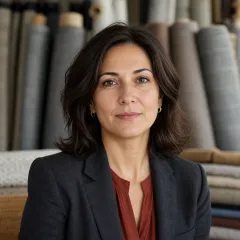
Lucia Bianchi
Lucia Bianchi is a woven apparel-fabric analyst covering cotton, linen, wool, rayon, denim, shirting, twill, satin, poplin, and blended garment fabrics. She applies the ISO 1833 series for fibre composition and ISO 105-C06 for laundering colourfastness while checking GSM, yarn count, usable width, shrinkage, skew, shade grade, drape, and surface defects. Her specification guides help designers, sourcing teams, and mills align fibre claims, lab dips, bulk tolerances, care conditions, and garment performance before production approval.